
Where and when: Machu Picchu, Peru, 29 May 2023
0600: Today is the highlight of our trip to Peru. We are visiting Machu Picchu. It is an early start as the guide picks us up from the hotel to drive to Ollantaytambo, where we will catch the train to Aguas Calientes.

To get to Machu Picchu, first you have to get to the town of Aguas Calientes, which can only be reached by train (there is no road). The trains to Aguas Calientes run from Cusco, Ollantaytambo and a couple of other nearby towns, but the most frequent departures are from Ollantaytambo. So the most efficient way to get to Aguas Calientes from Cusco is to drive to Ollantaytambo and board the train there.
0745: Arrive at Ollantaytambo Station, via Sacred Valley. Ollantaytambo is at an altitude of 2800m, so heading here from Cusco helps in alleviating any altitude sickness symptoms as well.


Tip: I would highly recommend spending a couple of days in Ollantaytambo and exploring the Sacred Valley. There is plenty to see and many Inca ruins to visit. Also it is a good base if you don’t do well with the high altitude in Cusco. It is also possible to take a day trip to Machu Picchu from here.

0815: We all board the train. Our train ticket is checked against the passport prior to boarding. We are traveling on the Perurail Vistadome service with panoramic windows, which provide great views of the valley as you head to Machu Picchu.
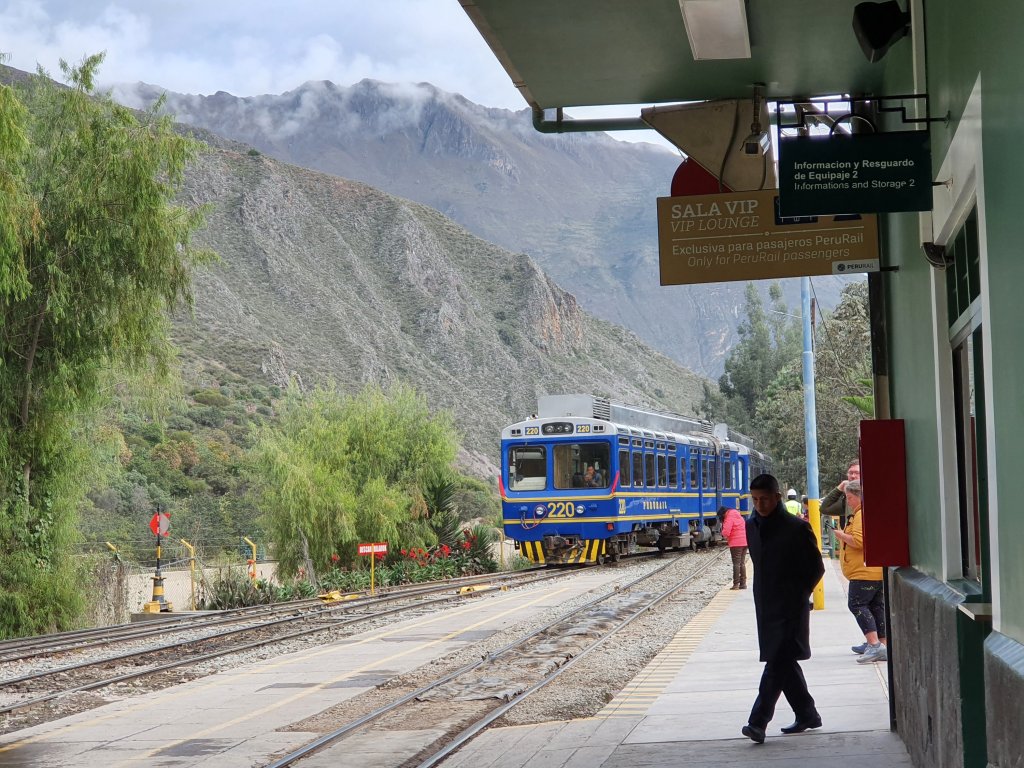
There are a number of trains to Machu Picchu, operated by two companies; PeruRail and IncaRail. Both companies offer a number of different services with different levels of comfort and service. Read more about this here and here.
We took the PeruRail Vistadome option which is middle of the range and one of the most popular options.
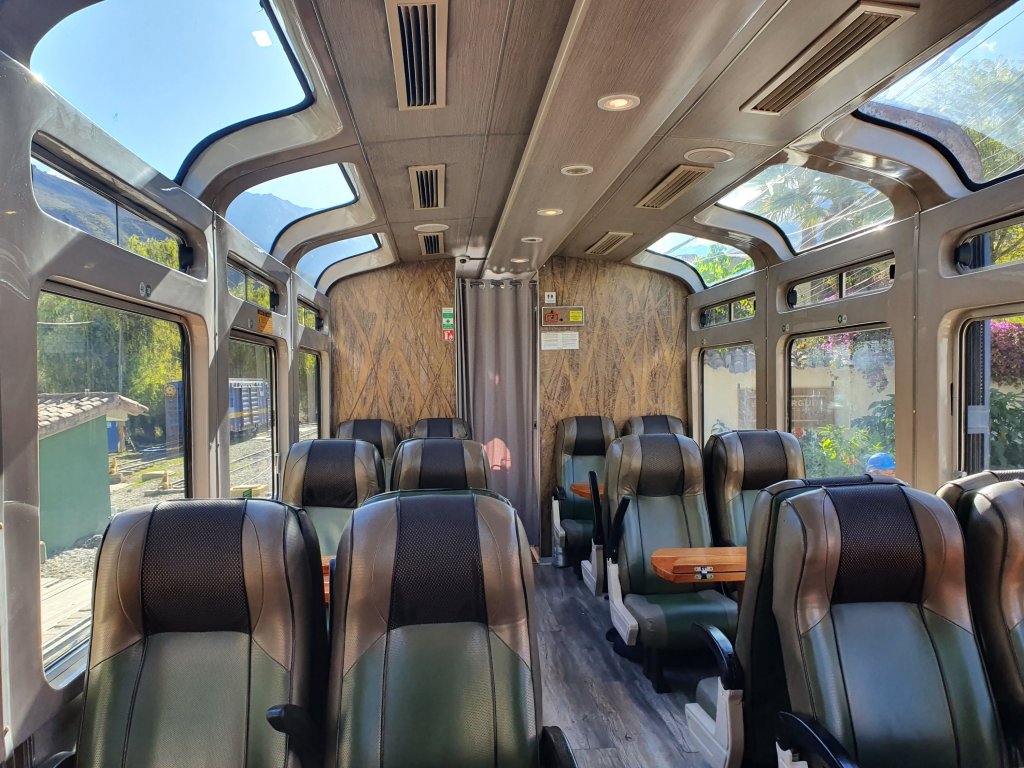
0830: Train departs on time from Ollantaytambo.
Tip: A little tip about luggage. We were told by our travel agent to pack overnight essentials into a small backpack for our 1 night stay in Aguas Calientes. This is because of the luggage restriction on the Vistadome service. On the train however, we found that there was actually more luggage space than we thought, with a luggage rack in each carriage with space for a couple of big suitcases. There is also space behind your seat for a small suitcase (if it can fit under a airline seat, then you will be fine).
About an hour in, a small drink and snack is served on board.

There are several small communities on the outskirts of Ollaytaytambo, but soon the train start to travel through the dense forest. The Urubamba river flows parallel to the track for most of the way.

On the way, we see the starting point of the 4-day hiking trail to Machu Picchu and some hikers and support crew on the way. The support crew carry all the cooking and camping equipment. Each tourist is allowed to take 6kg of personal items, which you need to carry yourself.
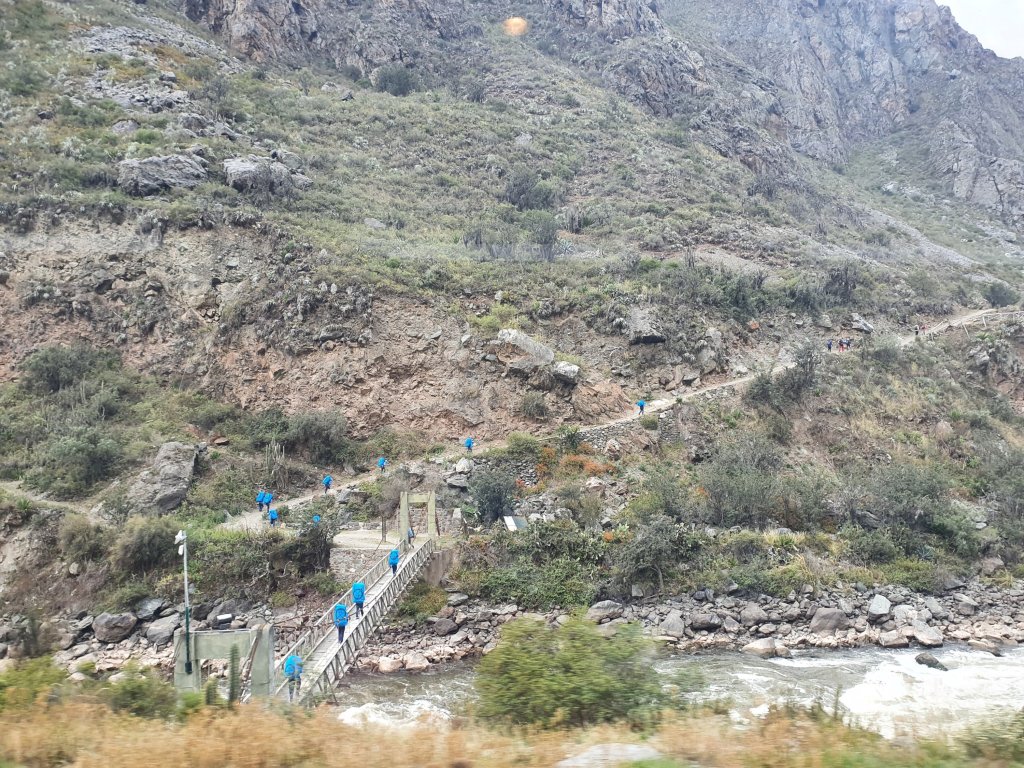
As the train gets closer to Aguas Calientes (at 2000m) the scenery changes, with low altitude flora and fauna becoming more common.

Just before we arrive at Aguas Calientes, the train makes a brief stop at Chachabamba, the start of the 1-day hiking trail to Machu Picchu.
Tip: If you don’t want to do the 4 day Inca trail hike and camping, the 1-day trail is a good option. You start your hike at Chachabamba and after a ~6 hour hike, arrive at Machu Picchu on the last part of the full Inca trail. You view the Machu Picchu citadel from the platform on the mountain and then you are taken down to Aguas Calientes on the bus. There is no camping required and you stay overnight in a hotel in Aguas Calientes. You get to explore Machu Picchu site the next day. I really wish I had known about this option before our trip. The main reason I didn’t do the Inca trail hike was the aversion to camping. So the 1 day hike is a good option that offers the best of both worlds.
0955: Train arrives at Aguas Calientes. The tour guide is here to pick us up and we drop off our bags at the El Mapi Lodge hotel. Aguas Calientes is at an altitude of 2000m, so altitude sickness is not an issue here.
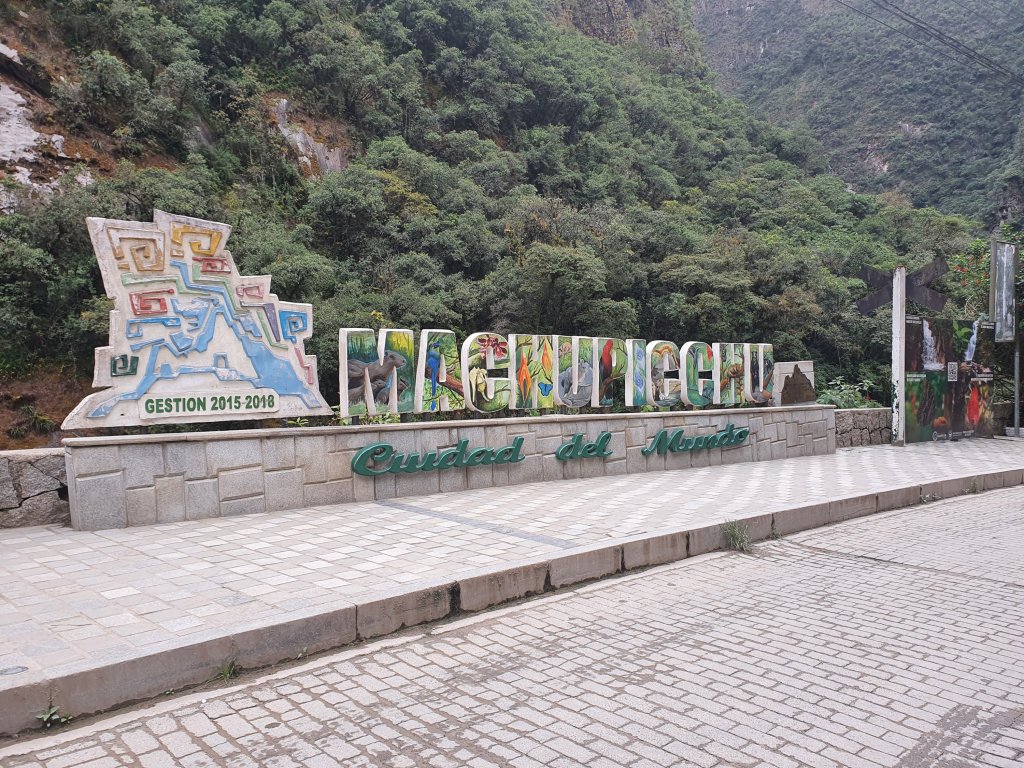
1015: From Aguas Calientes it is a 30 minute bus ride to Machu Picchu entrance. Only official tourist buses are allowed so you need to queue for the bus. Here they check your bus ticket (several times) as well as your timed entry Machu Picchu ticket.

1035: We board the bus after a 20 minute or so. According to our guide, this is a very short queue. Pre-Covid, Machu Picchu had 7000 entrants a day, and the wait time for the bus could be upto 1 hour in the peak season. Now (as of May 2023) it is at 2000 entrants per day, so the queues are much shorter.
Instead of taking the bus, you can also walk to the entrance to Machu Picchu, but this is a steep hike straight up the hill, and can take about 1 hour if you are in reasonable fitness.

1100: We arrive at Machu Picchu. There is a short queue to get in.
Tip: Don’t forget your passport. They do check it against the ticket at the entrance.
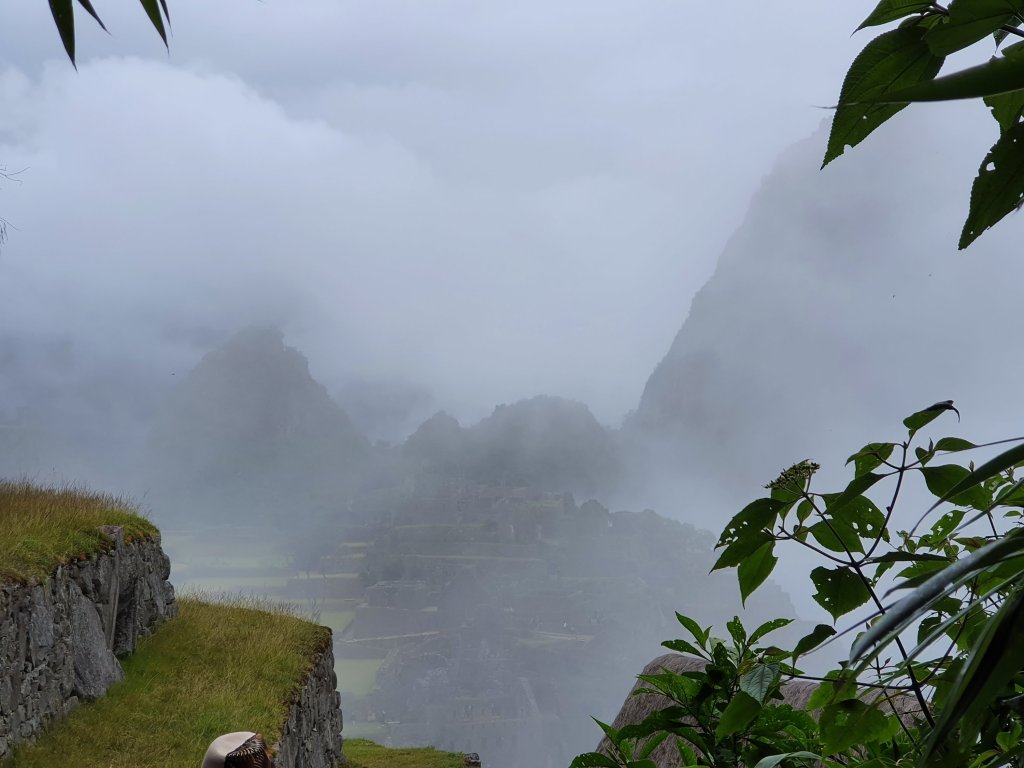
As we queue upto the entrance, it is really cloudy and foggy and looks as if it is about to rain. As we walk toward the world famous ruins, it is impossible to see anything because of the fog. We had resigned ourselves for poor weather and not being able to see much during our visit. But within minutes, the wind picks up and the fog clears away and we are treated to the wonderful picture postcard view of Machu Picchu.

Over the next 2.5 hours we walk around with our guide who explains many things about Machu Picchu to us.
About Machu Picchu
Machu Picchu is thought to have been built in the time of Sapa Inca (meaning “Emperor”) Pachacuti. Construction is thought to have taken about 70 years. The site was abandoned following the Spanish invasion of Peru and remained hidden till the early 20th century. It was re-discovered by US archaeologist Hiram Bingham in 1910 (about 90 years after Peru’s independence from Spain) when he was looking for the lost Inca city of Vilcabamba.
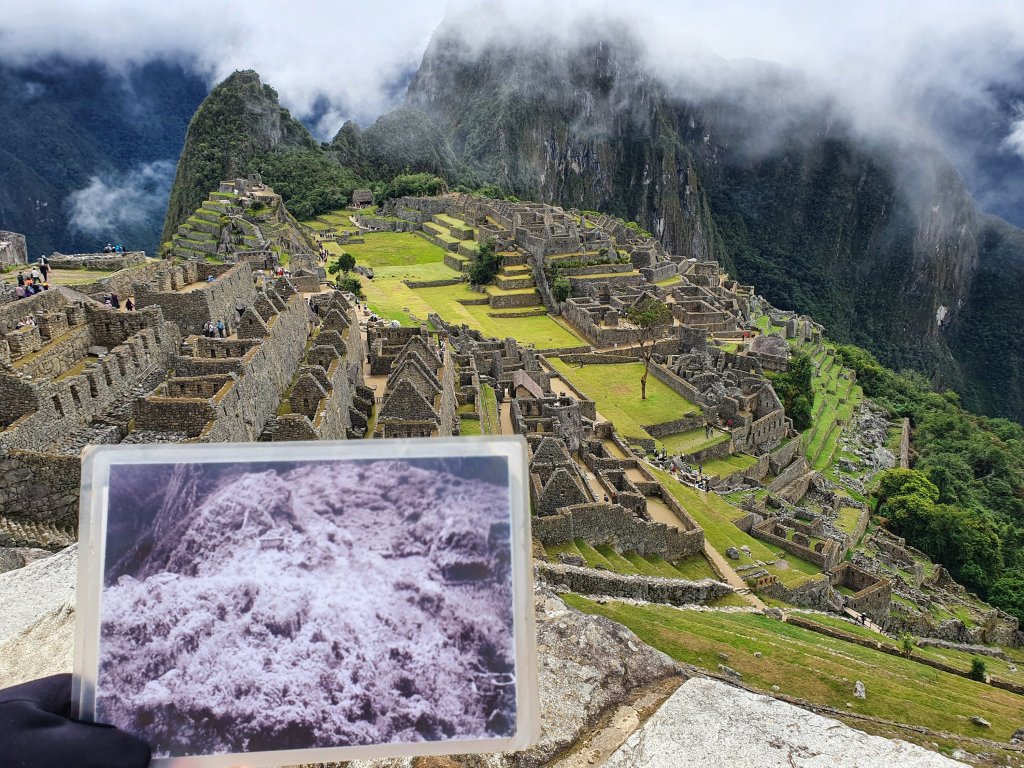
What was Machu Picchu used for? The real answer is: nobody knows. It is thought Machu Picchu could have been:
- The Inca Emperor’s personal estate/holiday home. A popular theory is that Emperor Pachacuti wanted a holiday home away from the crowds in Cusco and Sacred Valley, so he built a complex here. It was common for Inca Emperors to build their personal estates in the beautiful and highly fertile Urubamba valley.
- It was a boarding shool for the children of the Emperor and other high ranking inca officials.
- It was a nunnery for Inca high priestesses (based on a number of female only artefacts found in one part of the site).
- It was a outpost of the Inca empire at the entrance to the Amazon rain forest.
One or more of these could be the real reason why Machu Picchu was built.
Not only do we not know its purpose, we do not even know what the Incas called the site. Machu Picchu is actually the name of the mountain on which the ruins are located. Machu Picchu means “old mountain” and it was named by a local family who led Hiram Bingham to discover the site. Huana Picchu, meaning “young mountain” is the mountain that is the backdrop of all the pictures of Machu Picchu.

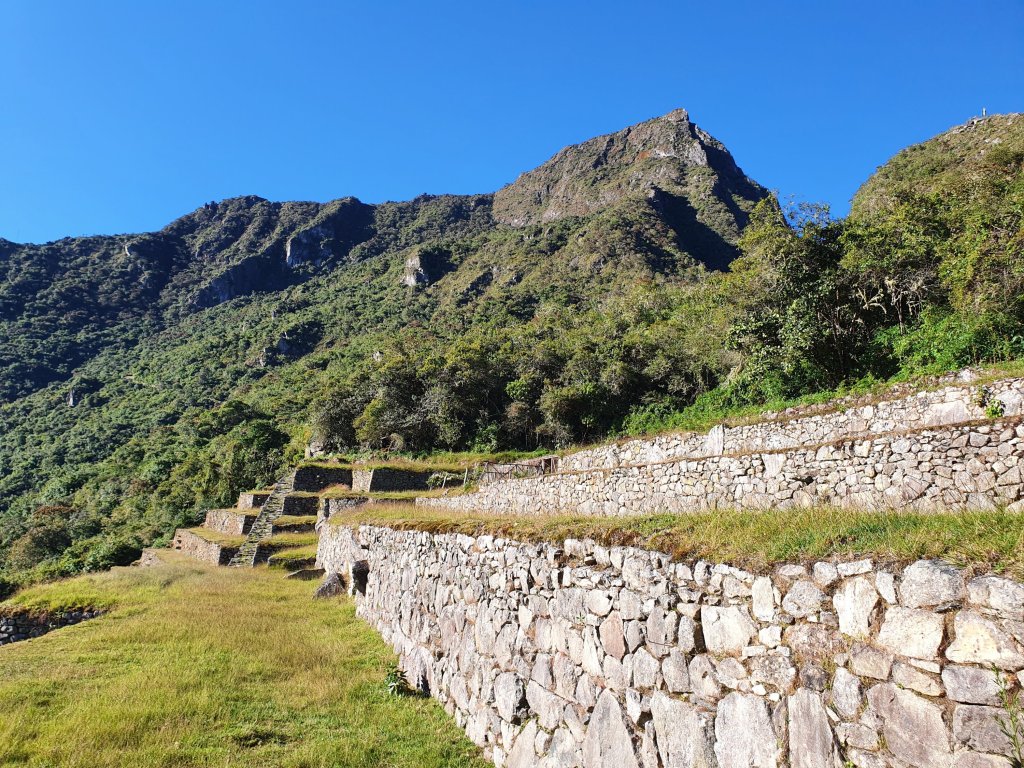
Site has many granaries, two small-ish Royal Houses, A sun temple and sun dial, staff housing, meeting hall, sacrificial temple, and several security gate houses.

Majority of the man made structures at Machu Picchu are the beautiful terraces on all sides of the mountain – they serve a dual purpose, both holding the slope of the mountain in place, thus preventing land slides and also providing space to grow crops for inhabitants of the site.

Our guide also pointed out the Sun gate (“Inti Punku”) to us. This is located on high up on Machu Picchu mountain, couple of hundred meters above the site, and is part of the Inca trail. If you arrive at Machu Picchu by hiking the Inca trail, this is where you will get your first look at Machu Pichu.
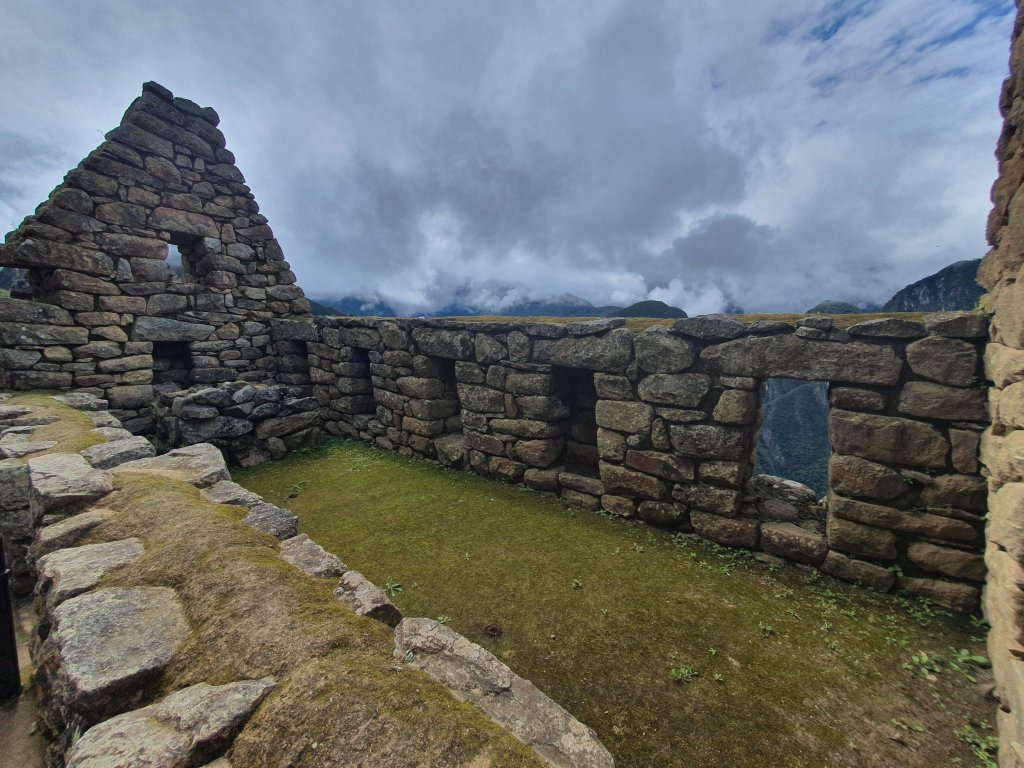
Machu Picchu has several circuits that cover different parts of the Citadel. All the circuits are one way and leads you to the exit. You cannot switch between circuits. So, to explore the site on a different circuit you need another (paid) entry to Machu Picchu which needs to be booked in advance. It is a bit galling that after all the trouble you go to get here, you can only see part of the site, but I guess it is needed to manage visitor numbers. We had a second visit booked for the site on the next day, so today we decided to go in Circuit 1, which is the main circuit that provides the picture postcard views.

The different circuits are clearely marked. Gatekeepers are positioned at strategic locations to ensure tourists don’t backtrack and/or jump from one circuit to another. Also some parts of the site are only open for few hours a day so if you want to see these, you have to be on site at the correct time.

If you are hiking up Huana Picchu, the entrace to this hike is also within the citadel, but you need a separate ticket for this.
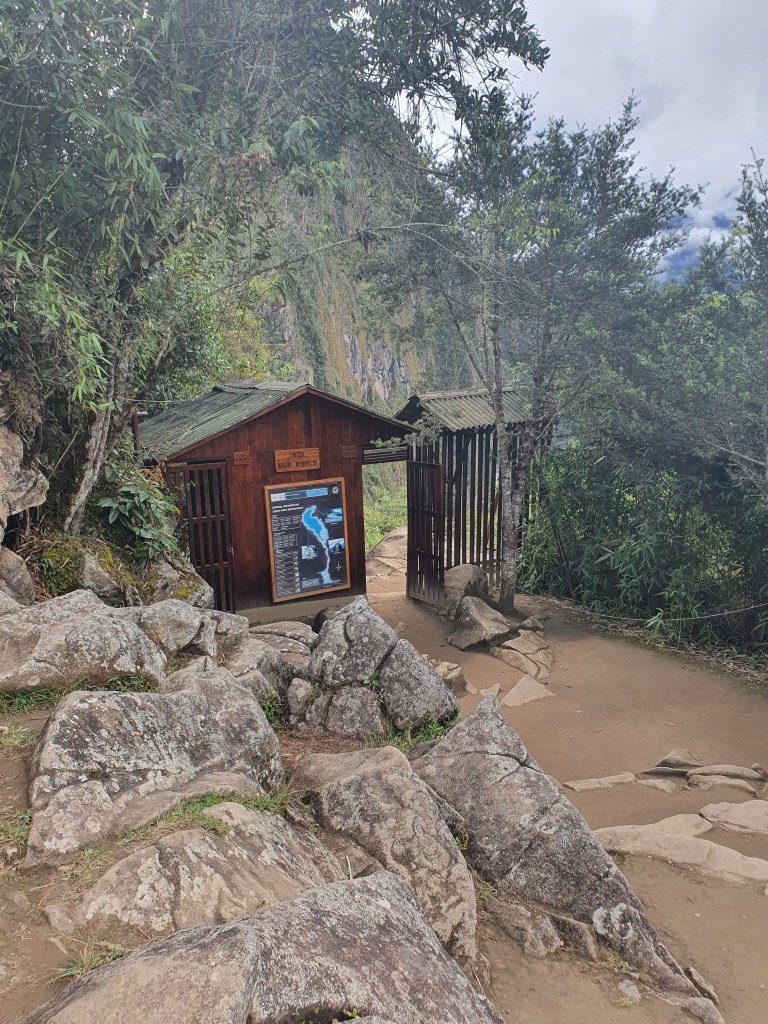
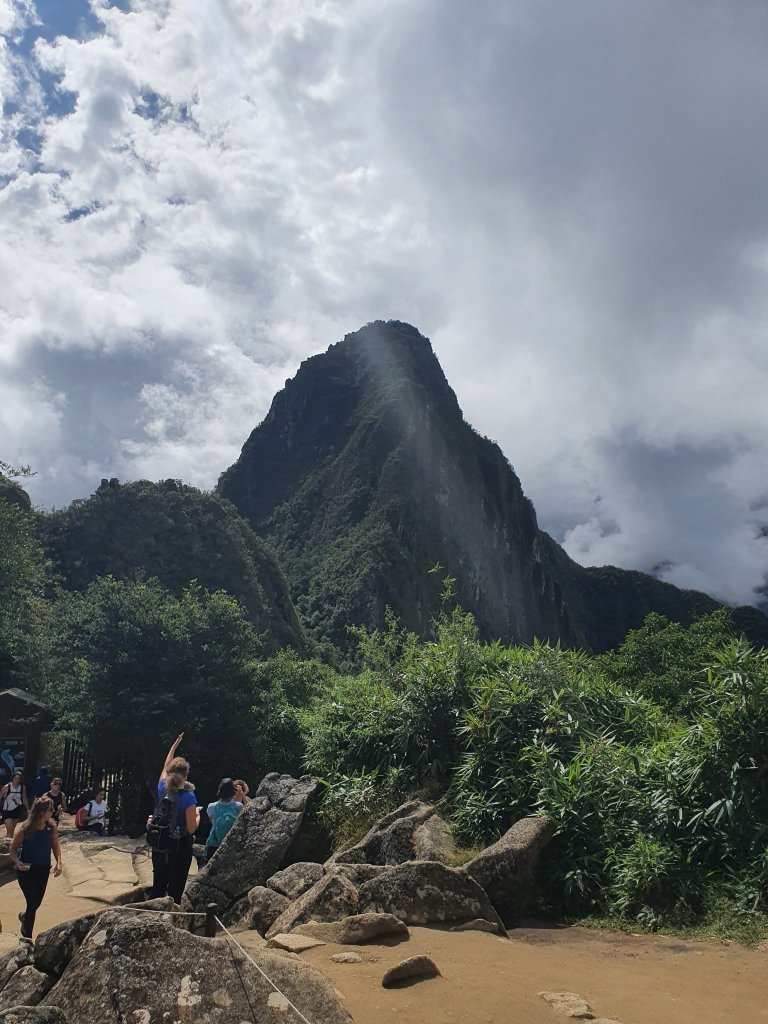
The site is designed so that visitors go through it as quickly as possible; There are no benches or resting places within the site nor are there any restaurants or toilets. For any of these you have to exit the site and you need a re-entry ticket.
Tip: If it is your first visit to Machu Picchu, book two visits on two consecutive days. This was included as part of our tour package. With two visits you can do two different circuits and cover most of site, and it also provides a good backup if the weather is bad on one of the days.
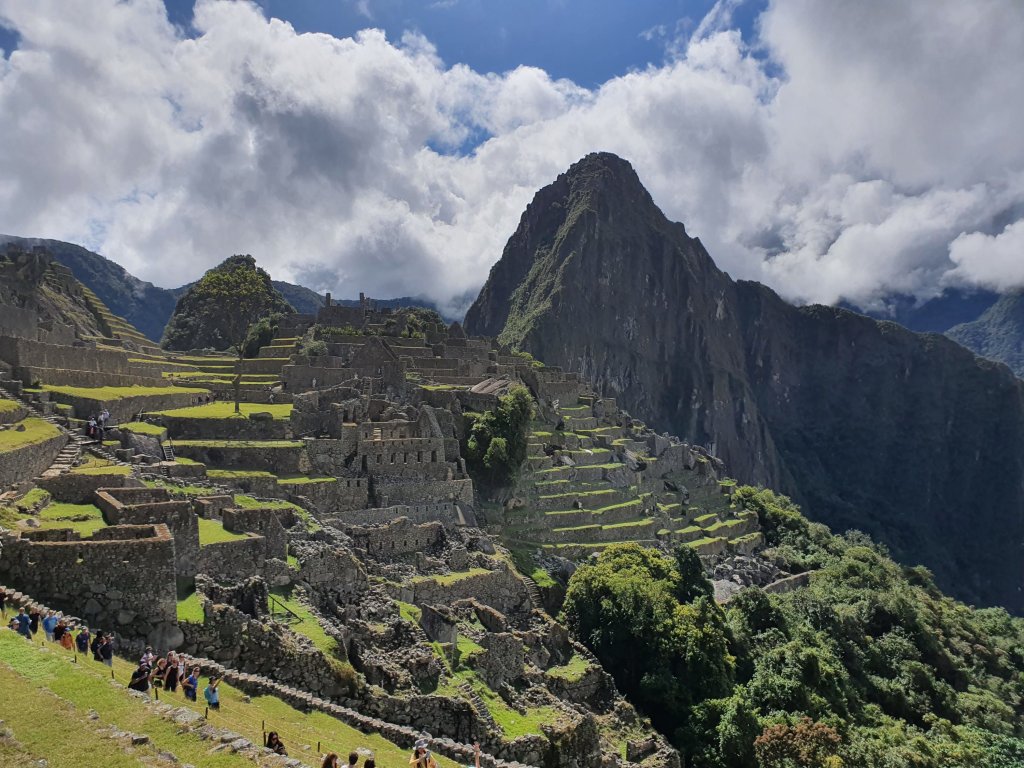
1335: We have made our way around Circuit 1 so the visit is over for today and we exit the site.
It has taken three flights, one car ride, one train ride and one bus ride to get to Machu Picchu. Was it worth it?
I think so. To me, the buildings at Machu Picchu are quite average. Sites such as Saqsaywaman we saw yesterday were far more impressive in terms of the size of the stones and building techniques used. But what makes Machu Picchu extraordinary is its location. Surrounded by tall mountains in the middle of a cloud forest, the scenery takes your breath away. It is also one of the best preserved Inca sites as it was not known to the Spanish. Many other Inca sites we saw in Cusco were destroyed, built over or pillaged to make colonial structures. But as Machu Picchu remained hidden, much of the original stonework was preserved, with only the wood based parts of the buildings such as the roofs, window panes and doors missing.
1350: After a short queue, we are back on the bus to go back down to Aguas Calientes.
1435: Leisurely lunch at Inkaterra Hotel. This is a nice hotel on the edge of Aguas Calientes – a great place to relax after hiking to Machu Picchu.


1542: After lunch we go to our hotel for the night, the El Mapi lodge to check in. After check in, we take the rest of the day to explore surroundings. Aguas Calientes (meaning “hot water”), is home to a number of hot springs. It is mainly a tourist town built to cater for tourists to Machu Picchu.

The town hit the headlines in December 2022 when it was cut off from the rest of Peru due to protesters blocking the railway from Aguas Calientes to Ollantaytambo. With no other way in or out of the town, residents and tourists alike were stranded for nearly 1 week, with supplies running low. Some tourists walked the 20 miles to Ollantaytambo along the railway track and the government arranged helicopter evacuation for vulnerable passengers before the railway was reopened.
There is a good market with many handicrafts so it is a great place to shop for sourvernirs.

Tip: There is not a lot to see in Aguas Calientes. There is a hot spring (open to the public), so take a swimsuit if you would like to explore this. There are some attractions outside the village but it is quite a long way away and without a car it is not easy to get to.
1900: Dinner at hotel restaurant. Also, my first chance to try a Pisco Sour. Pisco is a liquer made from fermented grape juice in the Pisco region of Peru. Pisco Sour is the signature cocktail for Pisco and is made with Pisco as the base liquor added with: freshly squeezed lemon juice, sugar syrup and egg whites; shaken over ice and topped off with a couple of drops of Angostura Bitters. The cocktail is believed to have been created in Lima in the 1920s.

Hotel Review: We stayed at the El Mapi Lodge in Agua Calientes for 1 night. The hotel is in a central location within the town, with easy access to the town square and many restaurants, bars and cafes. The hotel bar and restaurant are very nice as well. They serve breakfast from 4am, to cater for those who want to get to Machu Picchu before sunrise. The staff are also excellent. The hotel also has a spa, but we didn't get a chance to explore this.
 Diary of a Tourist
3 comments