Where and When: Luxor, Egypt, 3 Dec 2023
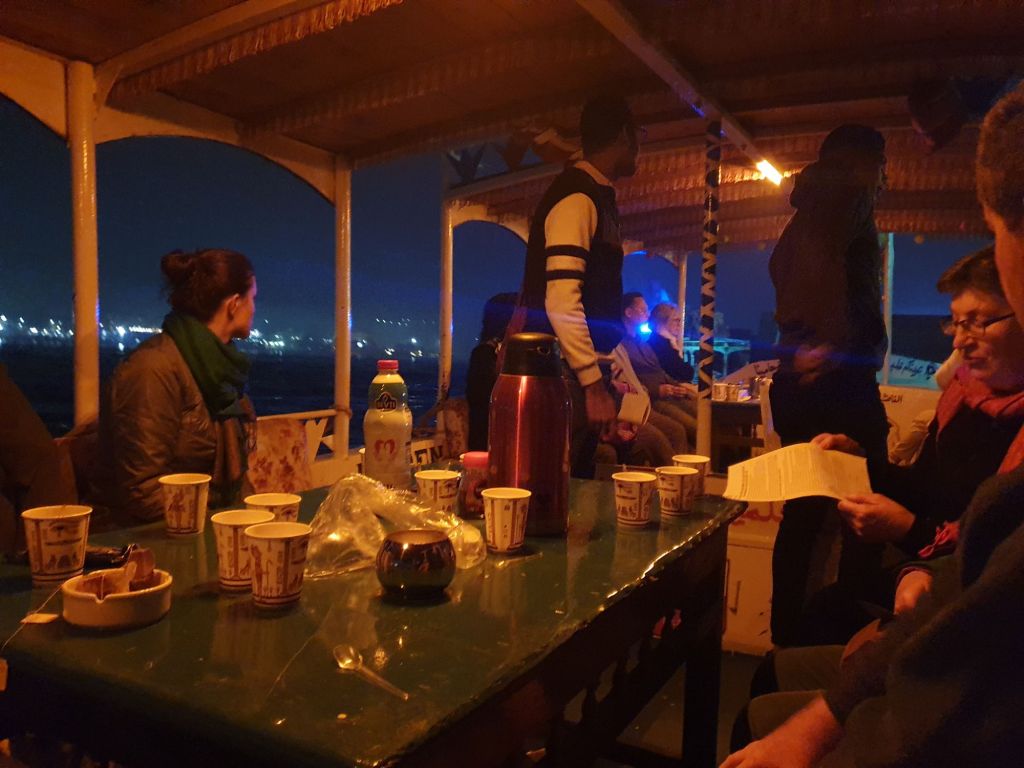
0415: Incredibly early start today – we are off to ride in a hot air balloon. Our pickup from the hotel took us to the jetty, where we boarded a motor boat. We are served tea and coffee and given the safety briefing for the balloon ride. The boat crossing takes 5 minutes. On the other side of the river, another van picked us up again and after picking up a few more passengers, brought us to the balloon launch site. (Google maps showed that the balloon launch site was only a 25 minute drive from the cruise ship, so not sure why it was a 90 minutes journey with 2 vans and a boat!)
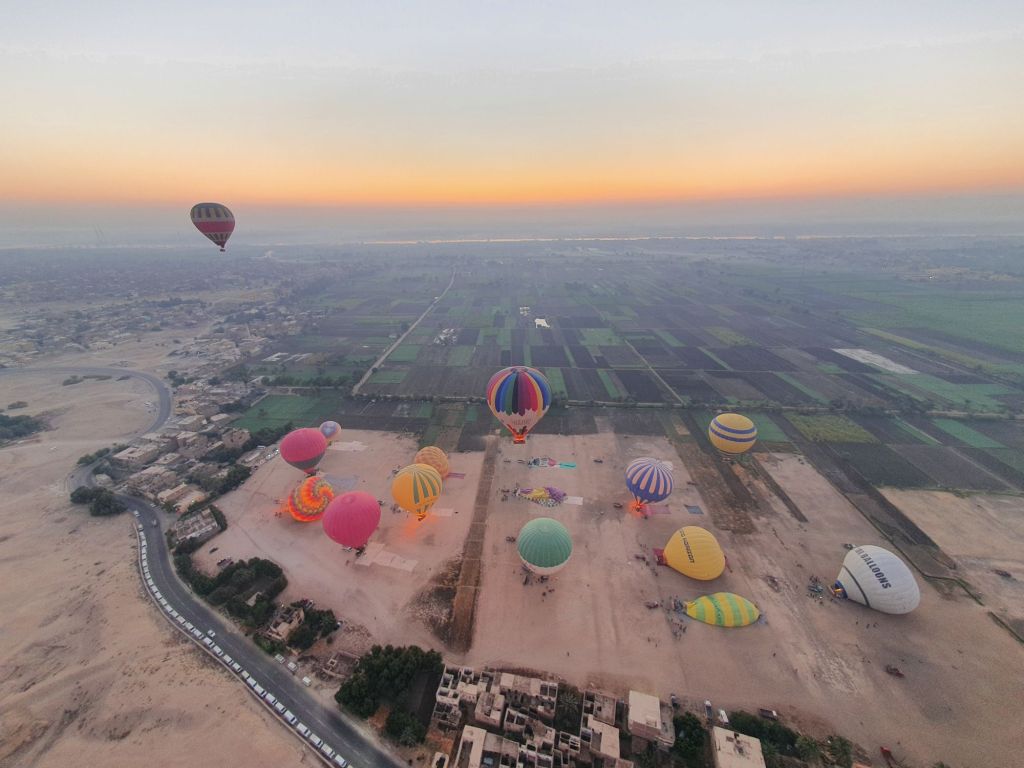
0540: The fun begins when they start blowing up the balloons. (I have never been on a hot air balloon, so this is a first for me). The balloon is laid flat on the ground and it is blown up first with fans, then gas powered flames.


The balloon rises remarkably quickly. In less than 15 minutes it has gone from lying flat as a pancake to completely upright; and we are quickly ushered into the balloon basket.
The basket is divided into 4 segments, holding 5 people each, so there’s 20 of us in total, plus the pilot. After that, it’s up and away.
Our balloon is one of the first to rise up, so we can see other ballons down below.
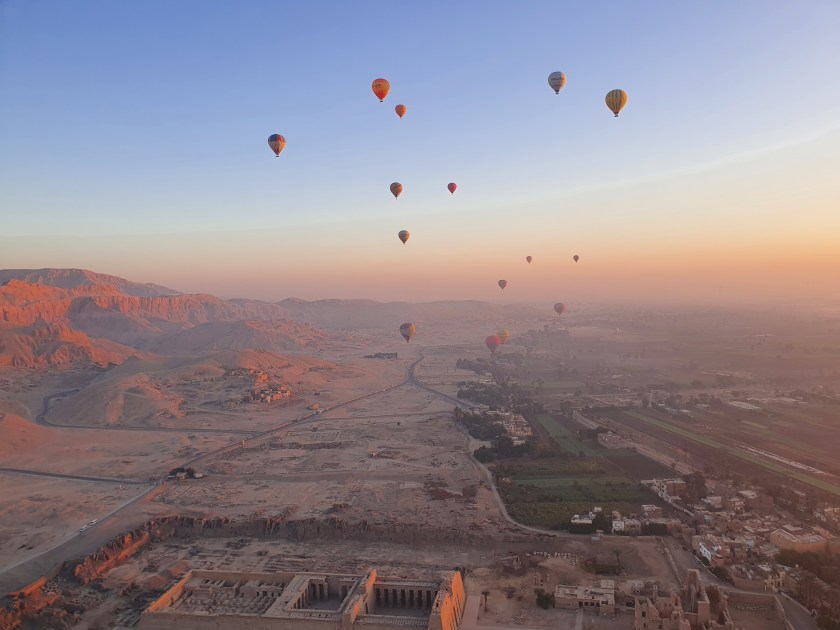
When we rise up all the way to the top, the scenery is spectacular. On one side is the Nile, and the other side is the desert; where you can see the Valley of Kings, temple of Queen Hatshepsut and the Valley of Queens.


From up high, you can really appreciate how Nile is the life-blood of Egypt; either side of the river is lush and green, thanks to the arable land and the irrigation systems. Beyond this thin fertile strip is the dry desert, where nothing grows (but is perfect for preserving mummified bodies)

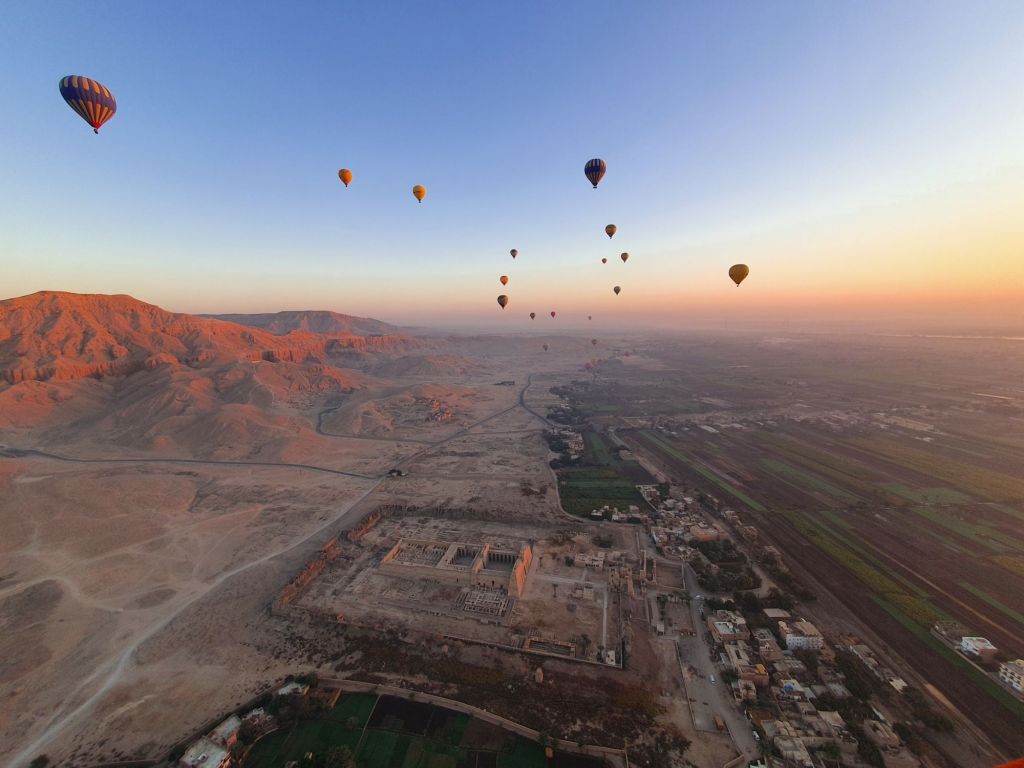
Although the landscape is spectacular, to me, what really makes the who experience worthwhile is seeing the other balloons. Made of vivid colours and floating at different heights, they look like a painting; and to top it all off, we also get to see a glorious sunrise.

After about 35 minutes of floating, we begin our descent. We can see the ground crew and the vehicles make their way to the landing site which is just off the Mortuary Temple of Ramses III.

The balloon basket touches the ground with a thump and bounces a couple of times, before the ground crew hold down and steady the basket. It is a very soft landing. They start to quickly deflate the balloon and in parallel we are helped out of the basket.
0715: Meet up with the rest of the group (who didn’t go on the balloon ride) and head to Queen Hatshepsut’s Mortuary temple.

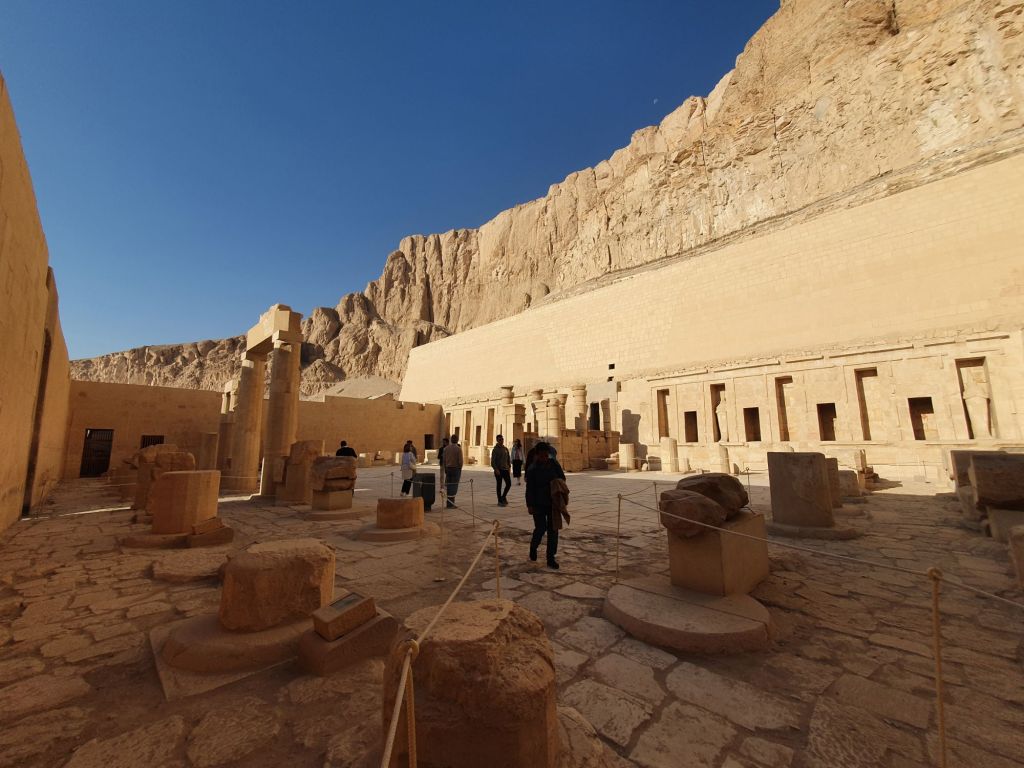
Mortuary temples are memorial temples, built to celebrate and remember a reign of a Pharaoh. This temple is special as it is the only known mortuary temple for a female Pharaoh. Queen Hatshepsut was the wife of Thuthmoses II, in the 19th Dynasty. When the king died she was made co-regent with her stepson, Thutmoses III. Several years into her reign, she declared herself as the sole ruler. She ruled for over 20 years, and was one of the most prolific builders of ancient Egypt. She extended the temple at Karnak, adding new obelisks. Later, she ordered the construction of two more obelisks to celebrate her 16th year as Pharaoh; one of the obelisks broke during construction, and a third was therefore constructed to replace it. The broken obelisk was left at the quarry site in Aswan, where it remains. Known as the “Unfinished Obelisk”, it provides evidence of how obelisks were quarried.

Queen Hatshepsut was succeeded by her stepson, Thuthmoses III. Towards the end of his reign, Thuthmoses III tried to erase any references to his stepmother from all monuments. Even today, it is not clear why this was done.
The mortuary temple was one of Queen Hatshepsut’s largest projects, although it was subject to damage when Hatshepsut’s reign was effectively erased from history.

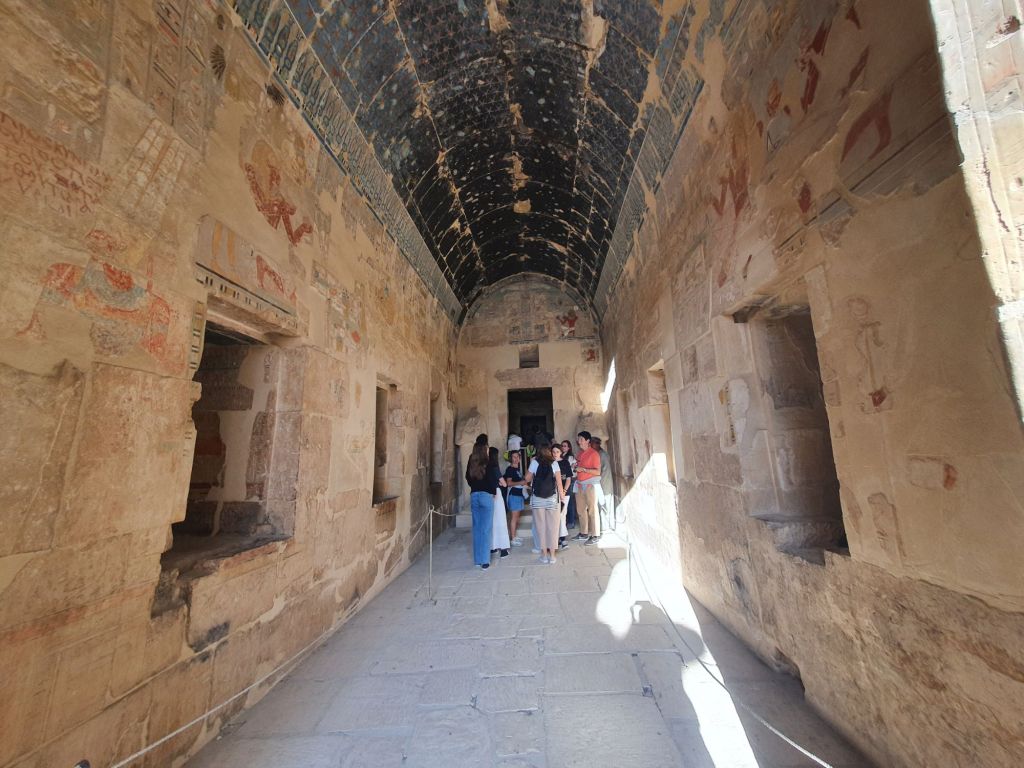
0745: Closer look around the temple. It has three massive terraces thag rise above the desert floor and into the cliffs of Deir el-Bahari mountain range. There are shrines to Hathor and Anubis and hieroglyphics telling the story of the divine birth of Hatshepsut, justifying her right to the throne.

0830: On our way to the Valley of Kings.
As the name implies, the valley of the kings is where kings are buried. Pyramids, although imposing, were too obvious as places of burial and attracted tomb raiders. So later on, Pharaohs decided to carve tombs deep inside a mountain range on the West bank of the Nile. The highest point on mountain range “El Qurn” looks much like a pyramid and Egyptologists believe this was one reason why this mountain range was chosen for the burial of so many royals and nobles.

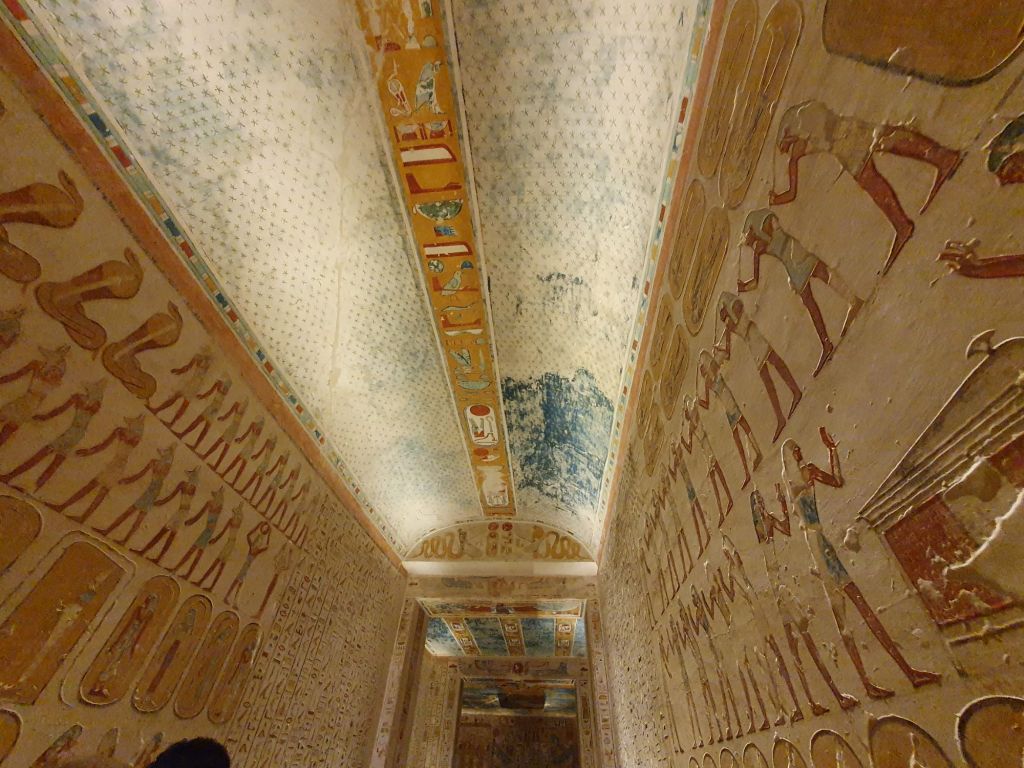
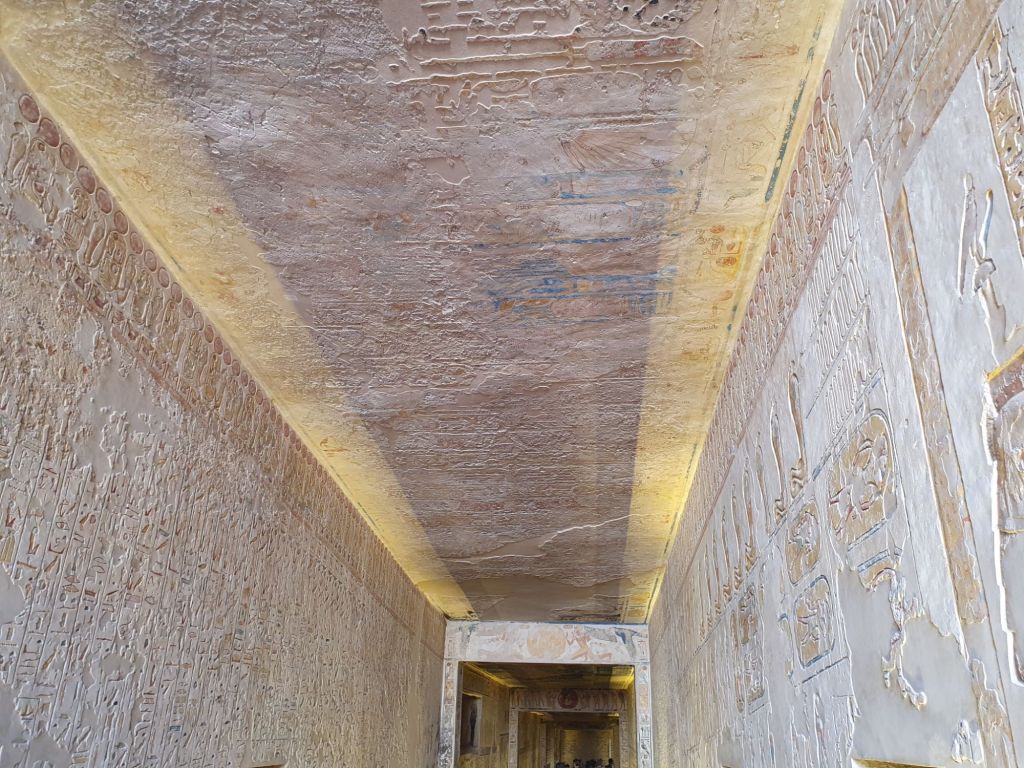
There are currently 65 tombs uncovered in the valley of kings. Ticket to enter the valley includes entrance to 3 tombs. We were able to go inside the following:
- Tomb KV2: Ramses IV (~1149 BC)
- Tomb KV6: Ramses IX (~1111 BC)
- Tomb KV16: Ramses I (~1290 BC)
Each tomb has a passageway that takes you into the burial chambers inside the mountain. The paintings and the colour is still well preserved, after 3000 years.





In the valley of the kings you can also visit other tombs for an extra fee. This blog has a good overview of all the tombs in the valley of kings:
Out of the extra tombs, we did visit the Tomb of Tutankhamun. This is one of the smallest tombs in the valley of the kings, but probably is the most famous. Unlike many other Tombs, it was found untouched and full of treasure when it was discovered in 1922 by Howard Carter.
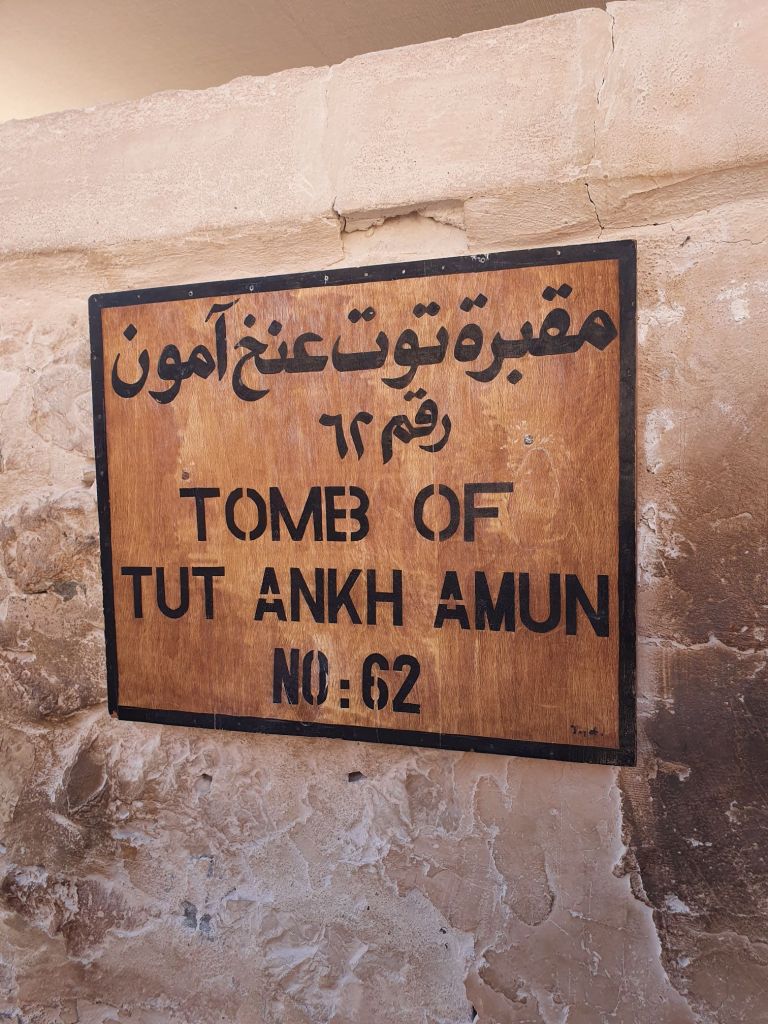

There is quite a steep stairway to the tomb underground. There are two chambers – the ante chamber and the burial chamber. Unlike the other tombs, only the burial chamber is decorated. It is thought that as Tutankhamun died unexpectedly, an unfinished tomb had to be quickly adapted for his burial. In the ante-chamber you can see the mummy of Tutankhamun.


Although we had time, we were too tired to visit the Valley of Queens (the consecutive early starts were catching up to us). Similar to the Valley of Kings, this part of the mountain contain the Tombs of Queens. The tomb of Queen Nefetari is the most famous tomb in the valley of Queens. It is also the most expensice of any tomb in Egypt – 1600 EGP (about 75 USD).
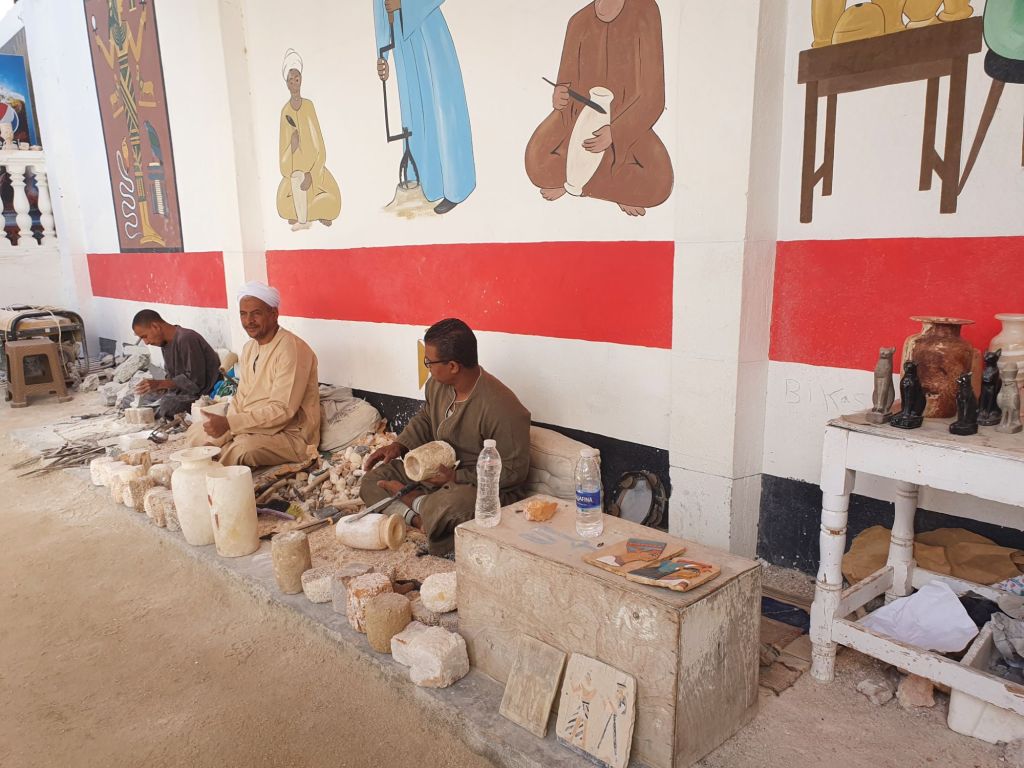
1120: After the Valley of Kings, we visited an Alabaster workshop. Here we were able to see how Alabaster stone is hand carved into statues and homeware.
1200: Brief stop at Colossi of Memnon. The Colossi of Memnon are two massive stone statues of the Pharaoh Amenhotep III, which were part of the Mortuary Temple of Amenhotep III, built in 1350 BC.
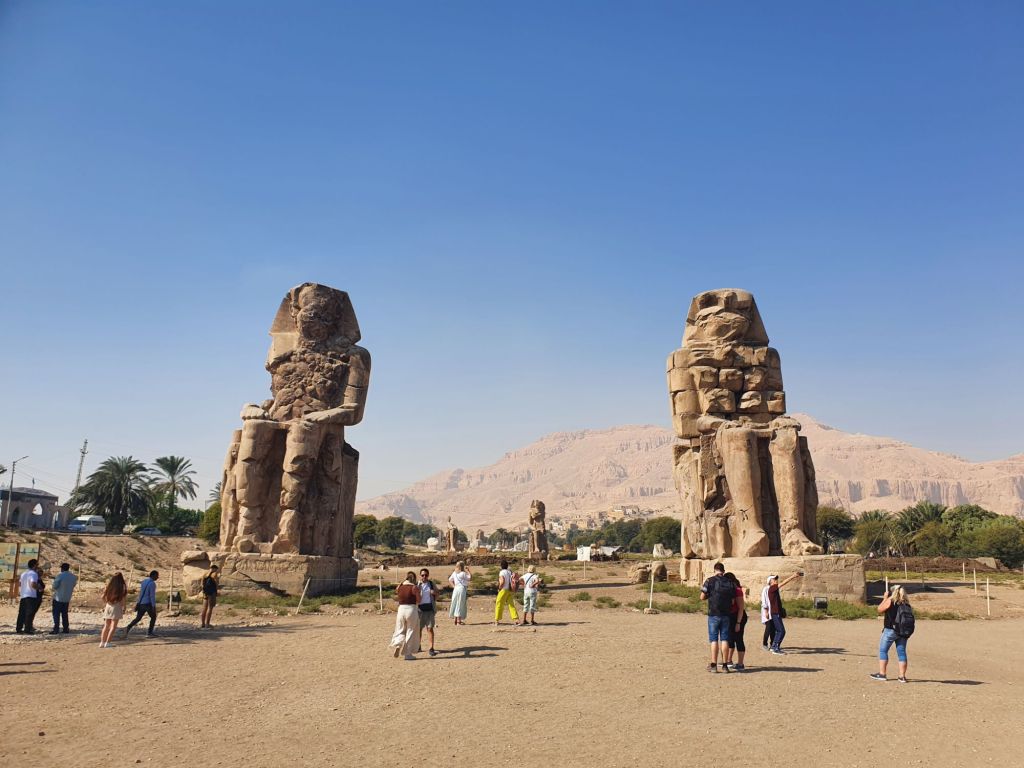
In 27 B.C., an earthquake damaged the Northern Colossus, collapsing its top and cracking its lower half. After the earthquake, the statue started to “sing” at dawn. (Today, scientists believe early morning heat caused dew trapped within the statue’s cracks to evaporate, creating a series of vibrations that echoed through the thin desert air). By 20 BC, tourists from around the Greco-Roman world were trekking across the desert to witness the sunrise acoustic spectacle. The unearthly song is how these ancient Egyptian statues wound up with a name from ancient Greece. According to Greek mythology, Memnon, a mortal son of Eos, the goddess of Dawn, was slain by Achilles. Supposedly, the eerie wail from the cracked colossus was him crying to his mother each morning.
1300: Back at the boat for lunch and a rest in the afternoon.
1645: Visit to Luxor museum.
This is a modern museum with relics from new kingdom era found in Luxor and the valley of kings. Compared to the Egyptian museum a couple of days ago, this museum is much more modern, with lot of description plaques, so you can visit this museum by yourself.


1900: Back at the boat and finishing the day with some retail therapy in the mini mall at the cruise ship. We had looked at some local cotton trousers earlier today at the valley of the kings and bargained hard (or so we thought) and bought it for 50% of the asking price. So imagine our surprise the ship’s clothes shop was selling the same thing for less than at the market! Needless to say, we bought several more pairs of trousers!
2000: It’s the end of another very enjoyable (but tiring) day in Egypt. As we wind down, the boat leaves Luxor, heading up river.

 Diary of a Tourist
Nice post
LikeLiked by 1 person
Fascinating. I didn’t know the reason it was called Valley of the Kings/Queens, so thanks for enlightening me. I just love hot air ballooning (requisite early morning start time notwithstanding). We did one in New Mexico many years ago and it was magical. Would do it again in a heartbeat, including in Egypt. Can’t believe there were people who didn’t sign up! (Or maybe space ran out or they had a fear of heights – those are the only two acceptable reasons to miss it – haha 😉).
LikeLiked by 1 person
Totally agree with you- it was a fantastic experience. I’d do it again in a heartbeat!
LikeLiked by 1 person